Planning Australia and New Zealand? Don’t Make This Itinerary Mistake

By Michael Nees20 November 2026 · 10 min read
Sydney Harbour, the Great Barrier Reef, Uluru at sunset, perhaps the Great Ocean Road. Then across to New Zealand for Auckland, Rotorua’s thermal valleys, Queenstown, and a cruise on Milford Sound.
It sounds like a wonderful holiday. And it can be. But the mistake is assuming that because these places fit neatly onto a map, they will fit neatly into your time away.
The hard part is not choosing between Australia and New Zealand. It is managing the distances between the experiences. Australia is about 29 times bigger than New Zealand, and the best way to explore each country is quite different.
After 35 years planning these trips, I keep coming back to four decisions: when to go, how much time to give each country, how to travel within them, and how to arrange the bookings. Get those right, and the holiday becomes far less exhausting.
Key Takeaways
- Choose your travel month first because seasonal conditions determine which regions fit comfortably together.
- Outside winter, allow roughly two thirds of your trip for New Zealand.
- Fly between Australian hubs and make the road journey part of your New Zealand holiday.
- Arrive in one country and depart from the other to avoid unnecessary backtracking.
First, Understand the Scale of the Trip
There is no road between Australia and New Zealand. Around 2,000 kilometers of the Tasman Sea separate them, with a flight from Sydney to Auckland taking roughly three hours.
Here is the comparison that often surprises people: Sydney to Cairns, the gateway to the Great Barrier Reef, also takes about three hours by air. Traveling between two Australian destinations can take as long as traveling between the two countries.
By road, Sydney to Cairns is approximately 2,400 kilometers. That is not a little coastal detour to squeeze between other plans.
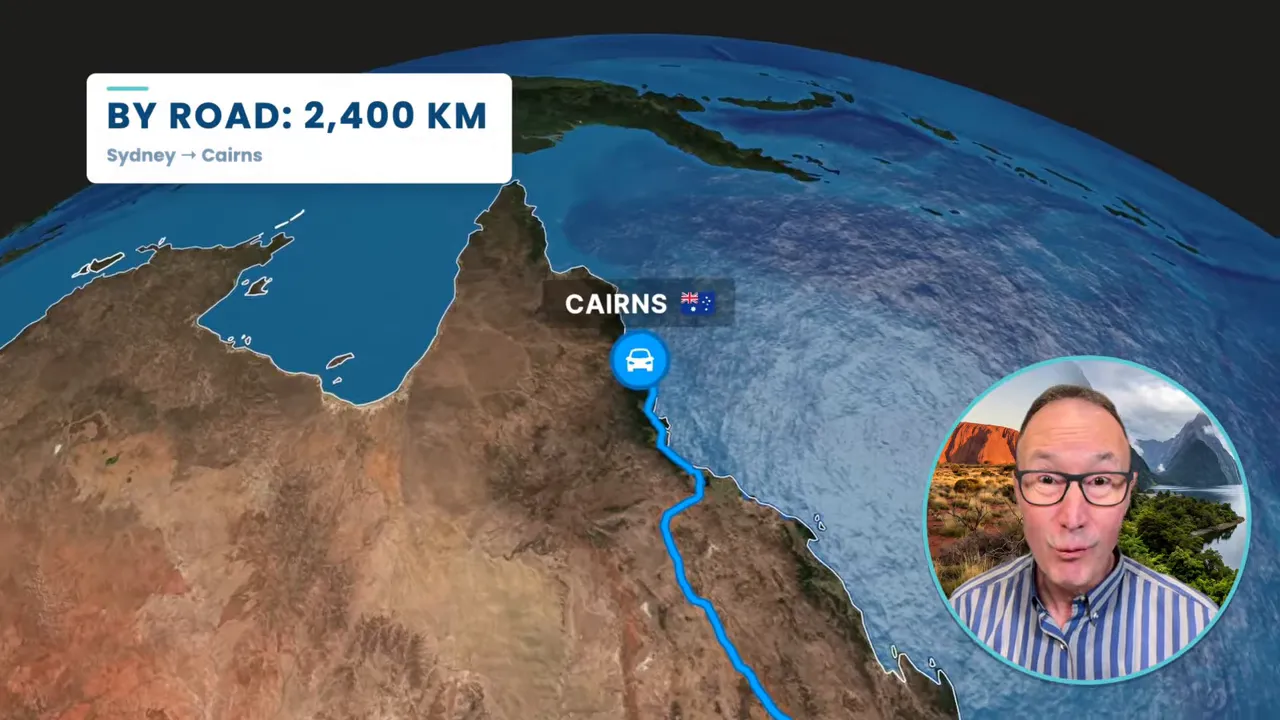
For a useful sense of scale, Australia is roughly the size of the contiguous United States. New Zealand is closer to Colorado in area, or broadly comparable with Great Britain. You are planning a continent alongside an island nation, not two similarly sized destinations.
My starting rule is simple: choose no more than three Australian hubs, with at least three nights in each. Three is a ceiling, not a target. On a shorter combined trip, two bases will usually make more sense.
Decision 1: Choose Your Travel Month Before Your Route
Christmas and New Year look tempting. It is summer in New Zealand, and in the far south the light can linger until around 10 p.m. Long days are lovely for a road trip.
But the same months bring very different conditions to tropical Australia.
From November to April, Far North Queensland is in its wetter period and official cyclone season. Around November to May is also marine stinger season, so swimming involves precautions such as stinger suits on reef excursions and netted beach areas where provided.
Meanwhile, Uluru can experience temperatures from the mid 30s into the mid 40s Celsius during December and January. That changes your day considerably: early walks, then retreating from the heat by lunchtime.
Reef boats still operate during the wet season. It is not automatically a ruined holiday. But conditions and water clarity may not match the picture you had in mind.
Your travel month should determine the shape of your Australia and New Zealand itinerary. I use three broad seasonal approaches.
November to March: Let New Zealand Lead
For this travel window, give New Zealand the emphasis, particularly the South Island. In Australia, concentrate on southern destinations:
- Sydney
- Melbourne
- The Great Ocean Road
- Tasmania, if time allows
If tropical Queensland is essential, look toward the edges of the wetter period, such as early November or late April, rather than assuming midsummer will suit everything.
April to May and September to October: Balance Both Countries
These shoulder seasons are my first places to look for a combined trip. They offer a better opportunity to bring Sydney, the reef, Uluru, and a New Zealand road trip into the same holiday without such sharp seasonal compromises.
That does not mean every day will deliver perfect weather. It means the overall plan has a more comfortable starting point.
A couple I helped wanted to travel at Christmas. We shifted their trip to April without changing their budget. They experienced calm, clear conditions on the reef, walked around Uluru in about 25°C, and traveled through South Island autumn colors. They later told me that changing the month was their best decision.
If your dates are flexible, investigate April and May before committing to December and January. The separate guides to Australia’s travel seasons and New Zealand’s travel seasons can help you think through the tradeoffs.
June to August: Let Australia Lead
In winter, reverse the emphasis. This is when Australia’s tropics and outback become particularly appealing.
New Zealand can still be part of the holiday, but I would make it a shorter, more focused visit. Queenstown, Rotorua, and perhaps some skiing are possibilities, rather than trying to recreate a long summer road trip in shorter, colder days.

Decision 2: Don’t Automatically Split Your Time 50/50
Two weeks in Australia and two weeks in New Zealand sounds fair. But a holiday does not need to give equal time to each country to feel balanced.
The difference is in how the experiences connect.
In New Zealand, the journey itself is a major part of the attraction. The drive from Wanaka toward the West Coast is not simply transport between hotels. It belongs among the highlights.
Australia’s major attractions are more like separate pockets of experiences, with large distances between them. You fly into a region, settle into a base, explore, and fly onward.
For many first trips outside winter, my rule of thumb is roughly two thirds of your time in New Zealand and one third in Australia.
- About three weeks: Allow approximately 13 to 14 nights in New Zealand and seven to eight nights in Australia. Keep Australia to two hubs, such as Sydney and one other region.
- About four weeks: Around 18 nights in New Zealand and 10 nights in Australia allows room for three Australian hubs, such as Sydney, the reef, and Uluru.
- June to August: Flip the emphasis and give Australia the larger share.
- Under three weeks: My honest recommendation is to choose one country.
Those are planning guidelines, not a reason to ignore your interests. But they expose the cost of adding another destination. A third Australian hub needs nights, flights, and transfers, not just another pin on the map.
If adding it means rushing through New Zealand, something has to give. You will often experience more by covering less ground.
Decision 3: Fly Australia, Drive New Zealand
This is the transport rule that makes the biggest practical difference to a combined holiday.
A road trip is an excellent way to explore New Zealand. Applying the same idea to the long distances between Australia’s major highlights can consume days you would rather spend enjoying the destinations.
Sydney to Cairns can take three full days of driving. On a limited two-country itinerary, that is a substantial commitment simply to move between bases. A flight gets you into the tropics the same day without that extended road journey.
This does not mean avoiding all Australian driving. The Great Ocean Road is a different proposition from crossing huge distances just to reach your next hub. Use flights for the big Australian jumps and local transport for the experiences around each base.
Why Port Douglas Works So Well as a Base
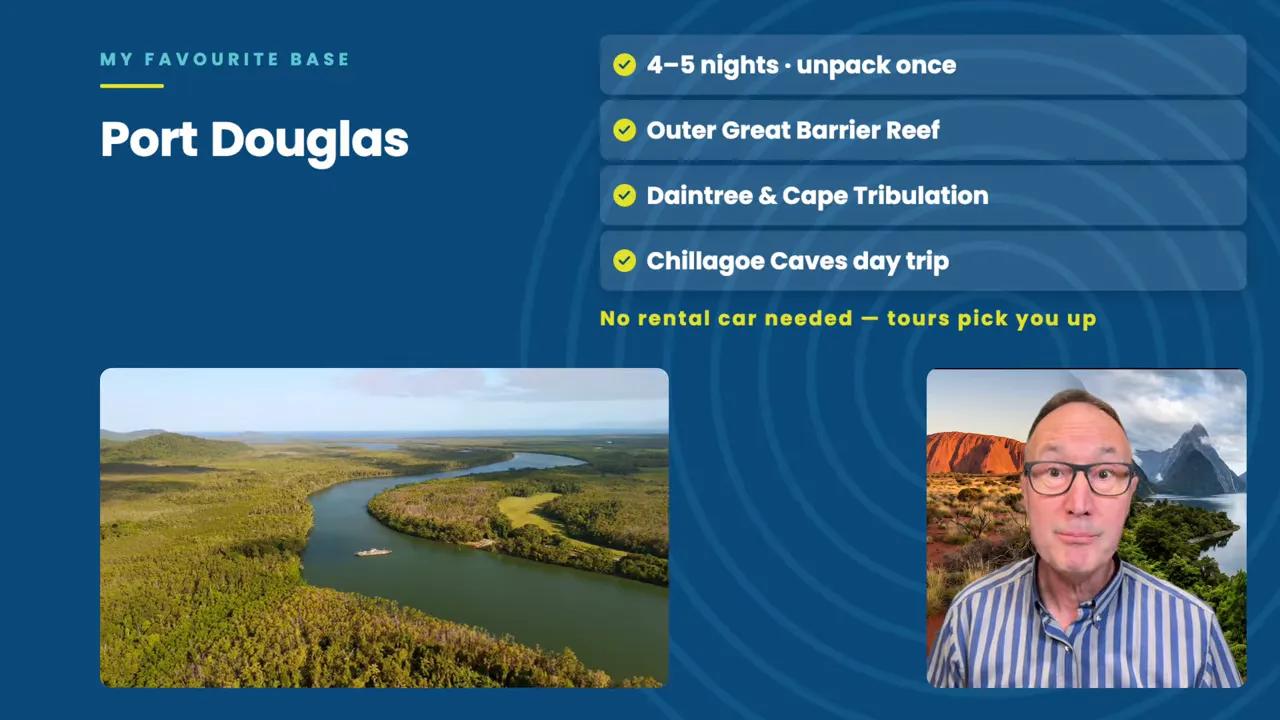
One of my favorite examples is Port Douglas, about an hour and a half north of Cairns Airport.
Stay four or five nights and unpack once. From that one base, you can arrange several quite different experiences:
- A day on the outer Great Barrier Reef
- A day exploring the Daintree Rainforest and Cape Tribulation
- A full day inland toward the Chillagoe Caves area, if that interests you
You may not even need a rental car for the stay. Reef excursions and many Daintree tours offer hotel pickups. Check the arrangements for your chosen accommodation and tours before paying for a vehicle that might spend much of the holiday parked.
The point is not merely to save driving time. It is to make the Australian part relaxing: one room, one base, several memorable days. For more detail, the Cairns and Port Douglas guide explores that region.
In New Zealand, Give the Drive Room to Breathe
In New Zealand, pick up a rental car and let the road become part of the holiday.
Many planned driving legs may sit around three to five hours, but those hours should not be treated as a challenge to complete as quickly as possible. The lookouts, lakes, and small towns between overnight stops are part of the reason to come.
Build a route that allows those stops rather than filling every day with driving followed by a tightly scheduled activity. You can compare New Zealand rental car options once the route is clear.
The simplest way to remember it is this: fly between the big country’s hubs, then enjoy the smaller country by road.
Free Three-Week Australia and New Zealand Itinerary: Use my free itinerary as a starting point for Australian bases and a New Zealand road trip. Download the Free Itinerary.
Decision 4: Book the Route Without Unnecessary Backtracking
Once the season, time split, and transport approach are settled, the bookings should support them. These are the five rules I use.
1. Fly Into One Country and Home From the Other
A return flight into one city can create an unnecessary journey back at the end.
Instead, look for an open-jaw itinerary, usually searched as a multi-city booking. For example, arrive in Sydney and fly home from Christchurch or Auckland. That removes the need to return to Australia solely for your flight home.
2. Choose the Order by Weather
Neither country always has to come first.
For a November trip, consider visiting Port Douglas early, before moving farther into the wetter season. For a journey beginning in March, New Zealand first and northern Australia in April can make more sense.
The principle is to place the tropical section toward the more favorable end of your travel window, rather than choosing the order out of habit.
3. Arrive in a City Before Starting to Drive
After a 14-hour long-haul flight, day one is not the time to begin a demanding drive on an unfamiliar side of the road.
Both Australia and New Zealand drive on the left. Start with a city such as Sydney or Auckland and allow a couple of nights to recover from jet lag before collecting a car.
4. Match Car Hire to the Route
For New Zealand’s North Island, a rental car loop can work well. On the South Island, consider a one-way journey from Christchurch to Queenstown or Nelson, depending on the route.
In Australia, favor short local hires where needed, or no car at all when tours and transfers cover your plans. Long one-way rentals across states can bring substantial drop-off fees.
Decide what the car is helping you do before booking it for the entire stay.
5. Treat Entry Requirements as Two Separate Jobs
Permission to enter one country does not cover the other. Check requirements for your passport separately and start early.
Eligible travelers may need a New Zealand Electronic Travel Authority, or NZeTA, and the applicable International Visitor Conservation and Tourism Levy. Australia has its own authorization and visa arrangements. Indian passport holders should plan for visitor visa applications for both countries rather than assuming an ETA will be available.
Check current eligibility, fees, and application requirements before applying. Do not confuse an authorization application charge with the total payable when a separate levy applies.
Both countries also take biosecurity seriously. Declare food items and clean hiking boots before arrival. Put this on your preparation list, not your list of things to remember at the airport.
Put the Four Decisions Together
These choices work as a chain, not four separate planning tasks.
- Your month sets the seasonal approach. Decide which regions make sense.
- That approach sets the time split. Give the right country the emphasis.
- The split sets the number of bases. Fit Australian hubs around enough time for New Zealand.
- The route sets the bookings. Arrange flights and cars without avoidable backtracking.
If you have flexibility, April, May, September, and October deserve serious consideration. They can offer a better balance between the two countries while avoiding the Christmas and January holiday rush, when campgrounds fill and rental prices peak.
The goal is not to collect eight famous places as quickly as possible. It is to have enough time and the right conditions to enjoy the places you choose. Fewer bases, sensible flights, and an unhurried New Zealand drive can turn a busy schedule into a genuinely memorable holiday.
Some links earn Virtual Journeys a small commission, at no extra cost to you.