Campervan in New Zealand? What to Know Before You Book

By Michael Nees7 November 2026 · 10 min read
Maui, Britz, Jucy or Apollo. Which campervan should you choose for New Zealand? Here is what catches many travelers out: six familiar rental brands belong to the same company, and a well-known logo does not guarantee a shower, a newer vehicle or the layout you actually need.
After 35 years of booking campervans, my advice is simple: compare the vehicle you will sleep in, not just the badge on the bonnet. Its age, bathroom, size and backup service will shape your holiday far more than the branding.
A campervan trip can be a wonderful way to explore New Zealand. But the right booking starts with understanding what you are getting and planning a route that works for it.
Key Takeaways
- Compare vehicle age, bathroom facilities, size and support rather than choosing by brand alone.
- Several major rental brands share ownership, but their vehicle categories differ.
- Plan your route around available depots, return deadlines and realistic driving days.
- Check the bond, insurance excess, cancellation terms and one-way fees before booking.
1. Know Whether You Need a Campervan or a Motorhome
The terms are often used loosely, but there is a useful distinction.
- A campervan is a converted van. It may have only a toilet, and you may need to turn the seating area into a bed every evening.
- A motorhome has a purpose-built living body on a truck chassis, with a shower, fixed toilet and often a permanent bed.
Neither is automatically the better choice. A smaller van may suit your travel style perfectly. A motorhome may make daily life much more comfortable. The mistake is booking one while expecting the features of the other.
And no, campervan hire is not automatically the cheapest way to see New Zealand. That depends on the level of vehicle you book. If you are still weighing up the overall approach, my car, campervan and motorhome comparison explains the differences.
The depot shapes your route
Most rental operators concentrate their depots in Auckland, Christchurch and Queenstown, although not every company operates in all three. Start with the available pickup and drop-off locations, then build your itinerary.
Return times matter too. Many vehicles need to be back by mid-afternoon. Wilderness, for example, specifies a 2:30 p.m. return, and the waste tank must be emptied before handover.
That means your final rental day is not necessarily a full sightseeing day. Allow for shorter driving days throughout the trip, and book holiday parks ahead during summer. Fit the route to the practicalities of campervan travel, not the other way around.
2. Understand Who Really Owns the Rental Brands
People often compare Maui, Britz and Apollo as though they were three entirely separate competitors. In fact, all of these brands belong to Tourism Holdings Limited, usually called THL:
- Maui
- Britz
- Apollo
- Mighty
- Cheapa Campa
- Hippie Campa
THL is listed on the New Zealand Stock Exchange. In Auckland, Maui, Britz and Apollo even operate from the same depot in Māngere, close to Auckland Airport. Same company, same yard, different price points.
That does not mean the products are identical. Vehicle age, specifications and service expectations can differ between brands. It does mean that comparing logos alone tells you very little.
Jucy, recognizable by its purple and green vehicles, sits outside that group. When THL acquired Apollo in 2022, the Commerce Commission required the sale of 110 Apollo motorhomes and the Star RV brand. Jucy bought them.
There are also family-owned independents. Wilderness has operated since 2004 with German-built motorhomes. Wendekreisen has operated since 1990 and mainly builds its own campervans in Auckland.
My starting point is never simply “big company or independent?” It is: which operator offers the right vehicle, at the right age, with dependable support?
3. Compare the Five Vehicle Price Levels
A higher rental price does not always buy a dramatically nicer interior. Often, the biggest difference is vehicle age. Rental vehicles can move down through brands as they get older, so a budget vehicle may once have been part of a more expensive fleet.
These five levels provide a useful starting framework. Treat the age ranges as guidance and confirm the current specification for the category you book.
Premium
Wilderness keeps its motorhomes for a maximum of about four years before retiring them. Maui vehicles are generally under two and a half years old, while Maui Elite vehicles are under 12 months old.
This is where I start when newer vehicles and comfort take priority over the lowest price.
Mid-range
Britz vehicles are generally under two and a half years old, with some seasonal models up to four years old. Apollo ranges from new to five years old, averaging about two years.
Notice the overlap with premium categories. A brand name is not a precise age guarantee, so check the actual rental category.
Value
Wendekreisen lists models from 2017 through 2023 and newer, and all 12 models discussed in its range include a toilet and shower. That makes it worth considering when you want bathroom facilities without premium pricing.
Jucy’s main fleet is newer than its oldest stock, but its Chill range contains older vehicles. Look beyond the headline brand and read the category details.
Budget
Mighty vehicles are typically five years old or more, alongside budget offerings from Cheapa Campa and Hippie Campa. Vehicles can pass down from Maui, Britz and Apollo over time.
There is nothing inherently wrong with choosing an older vehicle. Just understand what the saving represents: more years of rental use and potentially more interior wear.
Rock-bottom pricing
Some listings go much further back. One budget fleet shown on DriveNow listed vehicles from 2008 to 2010, approaching 20 years old.
Be particularly cautious here. Older rental vehicles can have hundreds of thousands of kilometers behind them. A low daily rate deserves a closer look at condition, specifications and support, not an immediate booking.
4. Avoid the No-Shower Trap
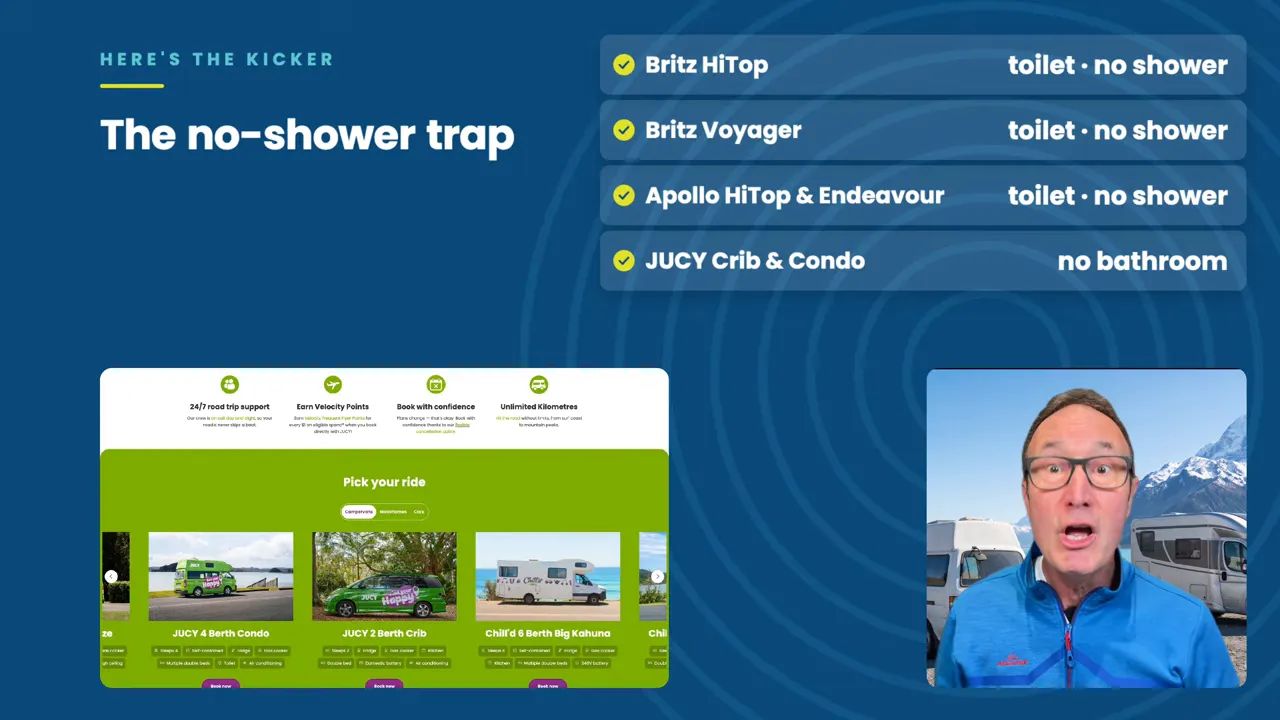
Here is the detail first-time renters often miss: even a major brand’s campervan may not have a shower. Some do not have a bathroom at all.
- Britz HiTop: portable toilet, no shower.
- Britz Voyager: toilet, no shower.
- Apollo HiTop and Endeavour: toilet, no shower.
- Jucy Crib and Condo: no bathroom.
You might be perfectly happy using holiday park facilities. That can be a sensible budget choice. The problem is discovering at pickup that your idea of a campervan bathroom and the rental specification are two different things.
Separate three questions: does it have a toilet, does it have a shower, and does it meet the requirements for your planned overnight stops?
For the 2026 freedom-camping requirements discussed here, the toilet must be fixed and usable while the bed is made up. Do not assume that carrying a portable toilet settles the question. Your overnight options need to match both the vehicle and the camping rules.
5. Check Age, Bathroom, Size and Backup
Once you have a shortlist, put every vehicle through the same practical checks.
Age and condition
Age usually brings more kilometers, more use and more opportunities for faults. Friendly depot staff are welcome, but they cannot make up for days without working hot water.
Read reviews for evidence about the vehicle itself, not just a pleasant pickup experience. Pay attention to recurring reports about water systems, maintenance and unresolved problems.
The bathroom arrangement
A toilet-only van and a vehicle with a toilet and shower create different daily routines. Check the layout carefully, including how the bathroom works when the sleeping area is set up.
This is something you will live with every night. It deserves more attention than the exterior photographs.
Size on New Zealand roads
The Wilderness range alone runs from about 5.9 to 7.4 meters. That extra meter and a half can make a real difference when parking in Arrowtown or driving along a narrow road.
For travelers accustomed to American RVs, even a 7.4-meter motorhome may feel relatively small compared with a typical Class C. But New Zealand roads are narrower, and you will be driving on the left.
Most couples are happier with something compact. Choose the space you need, rather than assuming bigger is better.
Support when something breaks
Reviews are a snapshot, not a guarantee, but they can reveal how an operator handles trouble. The Jucy Trustpilot figures I examined showed 3.6 stars across 1,222 reviews, with 31 percent rated one star and roughly half rated five stars.
That is a mixed picture, not a reason to declare every rental a disaster. The useful question is what happens when a vehicle has a leaking drain or faulty water heater.
Wendekreisen’s Google snapshot was 4.5 stars from about 290 reviews, with replies to every negative review. Wilderness replied to 98 percent of its Google reviews. Responses do not prove that every issue was resolved, but engagement is worth examining.
My preference remains straightforward: a newer, well-supported vehicle beats one chosen simply because it is bigger and cheaper.
6. Match the Campervan to Your Travel Style
Now for the practical match. These are the vehicle categories and models I would put on the shortlist for five types of traveler.
Honeymooners: small, newer and comfortable
I would prioritize a two-berth with a toilet, shower and a bed that can stay made up. You want a comfortable place to return to, without unnecessary bulk.
My shortlist includes the Wilderness Compact or Queen for 2 Slim, Maui Ultima and Britz Venturer. Confirm the layout of your selected model before booking.
Couples: the overlooked middle ground
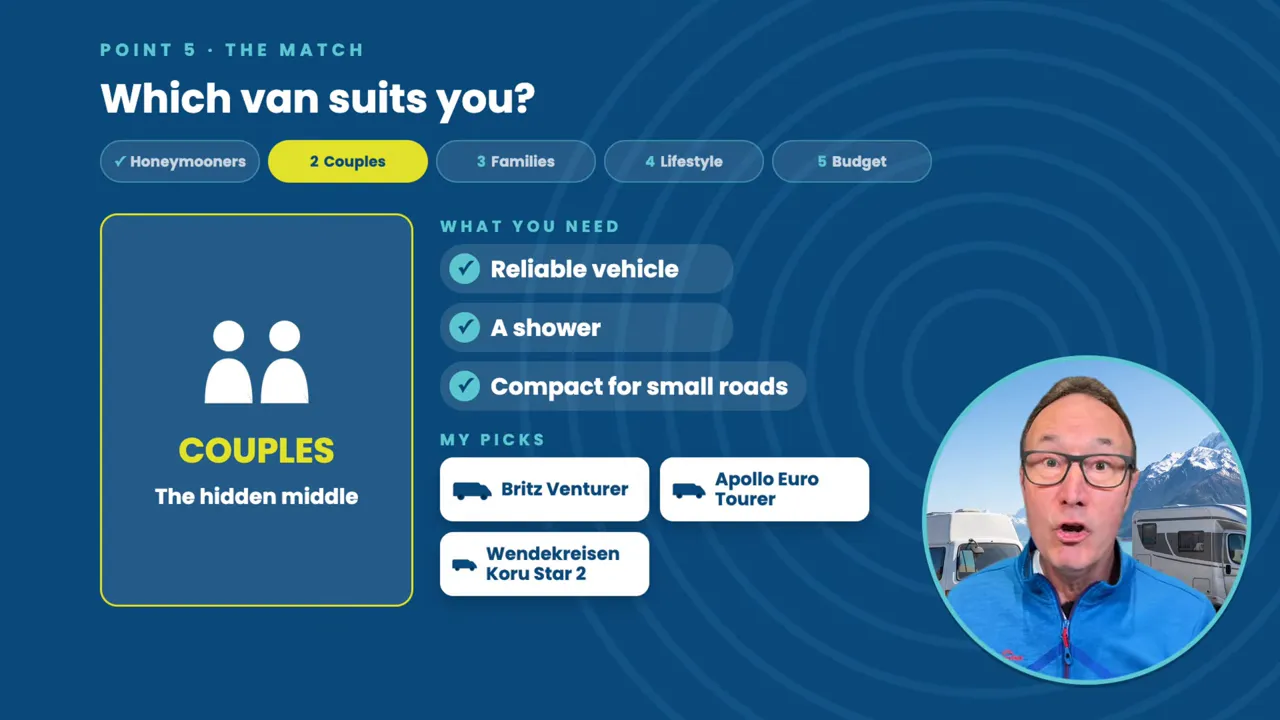
Many couples do not need luxury or a large living area. They need reliability, a shower and a vehicle that feels manageable on smaller roads.
I would compare the Britz Venturer, Apollo Euro Tourer and Wendekreisen Koru 2. The Koru 2 offers an automatic two-berth with a shower at a value-oriented price point.
Families: space with a shower
For a family needing four berths, I consider a shower non-negotiable. The convenience matters when you are managing children as well as the everyday camping routine.
Options I would compare include the Britz Wanderer or Odyssey, Maui Beach, Apollo Euro Camper and Wendekreisen Koru Star 4, including its 2024 model. For a tighter budget, consider the Wendekreisen Koru 4 Freedom from 2019 or newer.
Comfort-first travelers: premium motorhomes
If money is not the deciding factor, Wilderness is my top-end choice in New Zealand. Its motorhomes are under four years old, its Google rating snapshot was 4.9 stars, and its depots are in Auckland and Christchurch.
Maui Elite, with vehicles under 12 months old, is another option when a very young vehicle matters most.
Budget travelers: accept the compromises deliberately
Jucy or Mighty can work if you accept the vehicle’s age and are comfortable with its bathroom arrangements. Budget travel is not the mistake. Booking without understanding the compromises is.
Once you know your vehicle type, build the itinerary around its depots, sensible driving days and overnight stops. My New Zealand trip planner is designed to help with those details, with a first itinerary available free.
Plan Your New Zealand Campervan Trip: Build an itinerary around your depots, driving days and overnight stops. Try your first itinerary free. Try the Trip Planner.
7. Compare Like for Like Before Paying
The DriveNow campervan comparison site provides an overview of many New Zealand rental options. Enter your dates and pickup and drop-off locations, then narrow the results by:
- Vehicle age
- Toilet and shower facilities
- Number of berths
- Brand star rating
Now you are comparing a 2023 two-berth with a shower against a similar vehicle, rather than against a much older HiTop with different facilities.
After shortlisting, click through to check the bond, insurance excess and cancellation terms. These are part of the booking decision, not details to leave until later.
Wilderness is not listed on DriveNow, so compare its vehicles separately through Wilderness Motorhomes.
Three Final Rules for First-Time Renters
- Book early for December through March. This is New Zealand’s peak summer travel period. Plan holiday park bookings ahead too.
- Match the depots to your route. One-way hires usually cost extra. Check the fee before committing to a trip such as Christchurch to Queenstown.
- Take the full pickup walkthrough and film it. Record how the water, gas, toilet and power systems work.
At 9 p.m. in a Tekapo holiday park, that recording becomes your personal instruction manual. It is much easier than trying to remember every switch and valve explained at pickup.
The best campervan in New Zealand is not necessarily the cheapest, largest or most familiar brand. It is the one that fits your daily routine, your driving confidence and your route. Get those decisions right, and New Zealand really can be campervan paradise.
Some links earn Virtual Journeys a small commission, at no extra cost to you.