10, 14 or 21 Days in New Zealand? Don’t Make This Planning Mistake

By Michael Nees31 October 2026 · 10 min read
Ten days in New Zealand. Both islands, all the highlights. Sounds perfect, doesn’t it?
The trouble is, you could spend half your holiday driving and still miss some of the best places. A route that looks perfectly manageable on a map can feel very different when you are packing every morning, negotiating mountain roads and arriving just in time to check into another hotel.
In 35 years of planning New Zealand trips, I have learned that the best holidays are rarely the ones with the most stops. They are the ones with enough time to enjoy each place.
With 10 days, choose one island. With 14 days, choose between depth and a carefully planned taste of both. With 21 days, both islands become much more comfortable. And if you have two weeks, one domestic flight can replace roughly two days of road and ferry travel.
Key Takeaways
- Choose one island for 10 days rather than rushing through both.
- Allow for arrival, departure, ferry travel and weather before counting your exploring days.
- A domestic flight can replace roughly two days of driving and ferry travel.
- Three weeks allows a more comfortable two-island trip with longer stays at fewer bases.
Why New Zealand Takes Longer Than It Looks
New Zealand looks small beside Australia, but that is a misleading comparison. Australia is nearly 30 times bigger. New Zealand itself is roughly the size of the United Kingdom or the US state of Colorado.
Traveling from Auckland to Queenstown means more than 1,500 kilometers on the road, with a Cook Strait ferry crossing in the middle. That is not a small addition to a short holiday.
Most main roads have one lane in each direction. They wind through hills, climb mountain passes and cross one-lane bridges. Google Maps gives you a useful driving estimate, but I allow another 10 to 15 percent for real-world conditions such as bends, roadworks and bridges.
Then comes the part people forget: the stops.
A short walk to a waterfall. A lookout over a lake. Another photograph because the light has changed. These are not interruptions to your New Zealand road trip. They are the reason you came.
Christchurch to Lake Tekapo, for example, takes about three hours on Google Maps. Include lunch in Geraldine and a stop around Rakaia Gorge, and it becomes a comfortable half-day outing. You would be mad to race past all that scenery just to keep to a timetable.
A large motorhome needs more time again. Vehicles over 3.5 tonnes have a maximum speed limit of 90 km/h, hills slow your progress, and you need to allow faster traffic to pass.
Destinations also deserve longer than many people expect. Queenstown alone can fill three full days. Give it one rushed night and your strongest memories might be the car park and your hotel room.
Count Your Real Exploring Days First
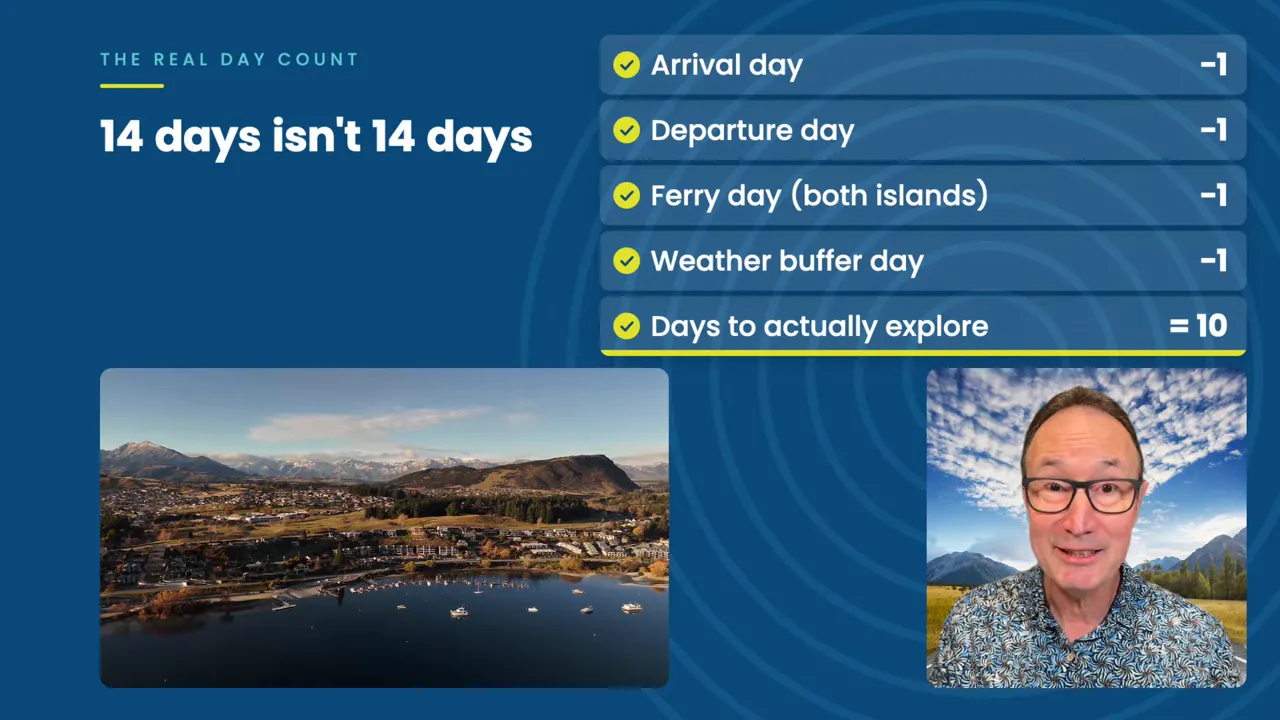
Flying in on day one and leaving on day 14 does not give you 14 full days to explore. Before choosing destinations, make a more honest calculation.
- Subtract your arrival day. After a long international journey, allow time to arrive and recover rather than depending on a full sightseeing day.
- Subtract your departure day. Packing, returning your vehicle and getting to the airport all take time.
- Subtract a ferry day if you are driving between islands. The crossing takes about three and a half hours, with check-in roughly an hour beforehand and onward travel afterward.
- Protect one weather buffer day. Leave some flexibility around the experiences that matter most.
For a two-island driving itinerary, that gives you a useful planning formula: 14 calendar days minus four allowances equals about 10 exploring days.
This is a planning framework, not a claim that every arrival or transfer day is wasted. You may enjoy parts of those days. The mistake is relying on them as though they were completely free.
The weather allowance is particularly important. Milford Sound receives around 6.5 meters of rain a year. Snow or heavy rain can close Milford Road at short notice, while Mount Cook can remain hidden in cloud for days.
A buffer cannot guarantee clear skies, but it gives you room to adjust. Without it, one poor-weather day can remove the highlight you traveled halfway around the world to experience.
My Four Golden Rules for a New Zealand Itinerary
Whatever your trip length, I build the route around four rules:
- Keep driving to a maximum of four to five hours a day, plus scenic stops. That is a ceiling, not a daily target.
- Stay at least two nights at each key location. One-night stays mean packing again almost as soon as you have unpacked.
- Allow one weather buffer day. Do not commit every available hour before you arrive.
- Count the ferry as a full travel day. The sailing time alone does not represent the whole transfer.
The principle is simple: fewer bases, longer stays. Two nights gives you a full day without changing accommodation. Three nights gives you more freedom to explore and respond to the weather.
10 Days in New Zealand: Pick One Island
With 10 days, the most useful decision is also the hardest for many first-time travelers: leave one island for another trip.
Apply the two-island formula and 10 days becomes six exploring days after arrival, departure, ferry travel and a weather allowance. Auckland to Wellington alone is about 640 kilometers, or seven and a half to eight hours of driving before you even reach the ferry.
That is a substantial commitment when your entire holiday is only 10 days long.
A 10-Day South Island Road Trip
For most first-time visitors, I would choose the South Island. Here is the nine-night route I would build:
- Christchurch: one night. Arrive and settle in before starting the journey.
- Franz Josef: two nights. Take the TranzAlpine train from Christchurch to Greymouth, then continue by rental car to Franz Josef.
- Wanaka: two nights. Give yourself a proper stay rather than making it another overnight stop.
- Te Anau and Fiordland: two nights. Use Te Anau as your base for this part of the trip.
- Twizel, Lake Tekapo or Mount Cook: two nights. Choose one base for the final part of the route, then return to Christchurch for departure.
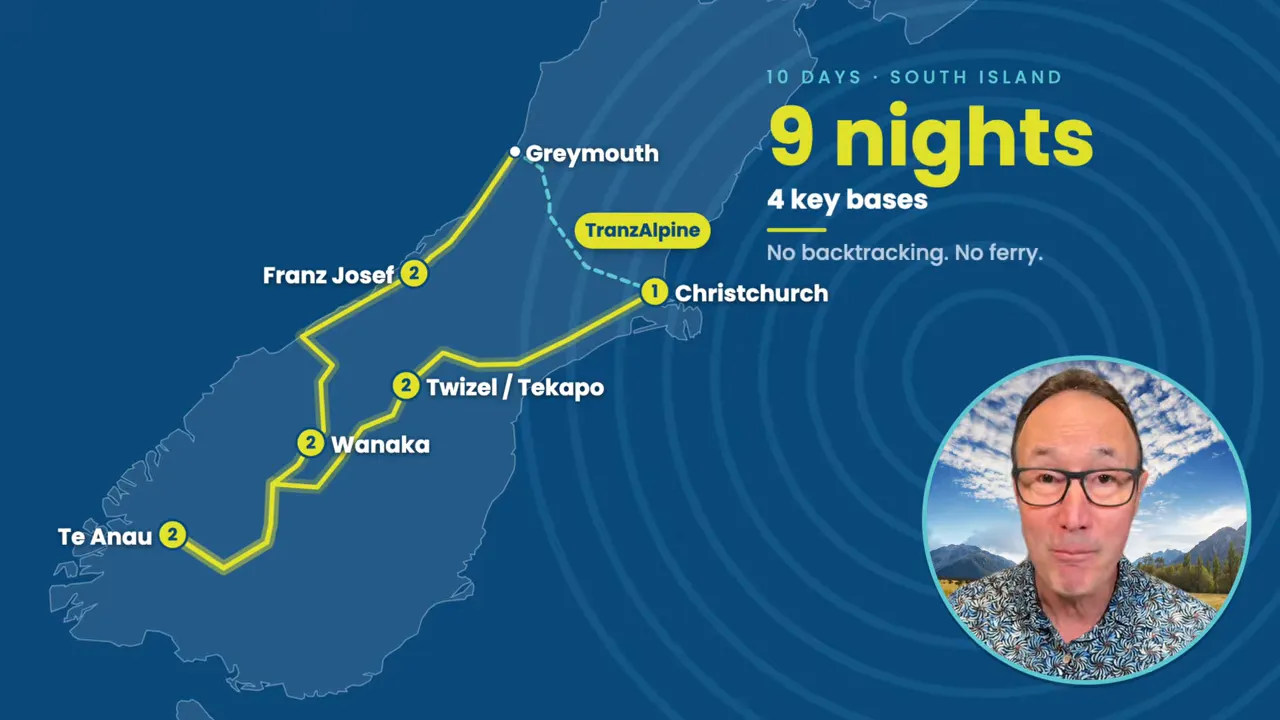
That gives you four key bases after your arrival night, with no inter-island ferry and a route that avoids retracing the whole journey. Notice what it does not do: add every famous destination simply because it appears nearby on the map.
It is a selective itinerary. That is its strength.
What About 10 Days on the North Island?
The North Island works too. Auckland, Rotorua, New Plymouth, Tongariro and the Coromandel are places to consider when shaping a North Island itinerary around your interests.
The important decision is not that everyone must choose the South Island. It is that 10 days works much better when you concentrate on one island.
And yes, that means missing the other one this time. Plenty of travelers return to New Zealand two, three or even four times. Your first visit does not have to contain everything.
14 Days in New Zealand: Two Honest Options
A two-week New Zealand itinerary is the trip I plan most often, and it is where people most frequently overcommit. Fourteen days sounds generous until you account for the practicalities.
There are two sensible approaches.
Option A: Explore the South Island Properly
Take the 10-day South Island framework and give it more breathing room. Depending on your priorities, use the extra time for the West Coast glaciers, whale experiences in Kaikoura or the beaches of Abel Tasman.
The shorter route already includes Franz Josef, so you might deepen that stay rather than add another destination. Alternatively, reshape the route around Kaikoura or Abel Tasman.
The point is not to fit all three into the extra days. It is to choose what matters most and preserve the relaxed pace. More time should improve the holiday, not merely lengthen the checklist.
Option B: Get a Taste of Both Islands
If both islands are important to you, I generally use a split of about one-third North Island and two-thirds South Island. Across a two-week trip, think roughly four to five calendar days in the north and nine to 10 in the south, with the combination totaling your available time.
Those are overall trip allocations, not uninterrupted sightseeing days. Arrival, departure and transfers still need to fit inside them.
To make this option work, the transfer between islands deserves particular attention.
The Flight Swap That Replaces Two Days on the Road
Many people assume a New Zealand road trip means driving the entire distance. With two weeks, that assumption can cost you valuable holiday time.
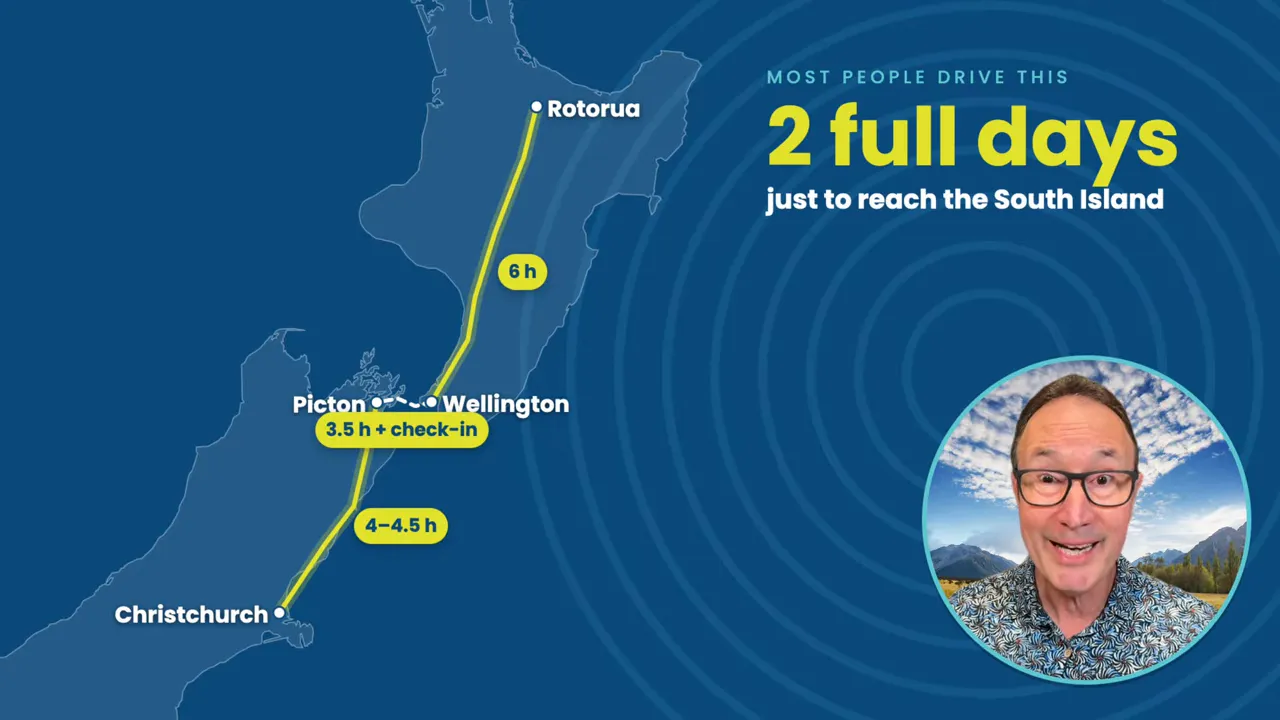
Consider the journey from Rotorua through Wellington and on to Christchurch:
- Rotorua to Wellington: about six hours of driving.
- Wellington to Picton: about three and a half hours on the ferry, plus check-in.
- Picton to Christchurch: another four to four and a half hours of driving.
That is roughly two full travel days just to get to Christchurch.
The alternative is to fly between islands. For an itinerary built around Auckland, return your North Island rental car there, fly to Queenstown and collect another car at the airport.
Auckland to Queenstown takes just under two hours in the air. Allow roughly half a day for the overall transfer instead of two days of road and ferry travel. Many New Zealanders make exactly this choice.
You are not removing all transfer time, but you are replacing a lengthy overland connection with a much shorter one. That can make a two-island, two-week trip considerably more rewarding.
If you are traveling in a campervan or motorhome, the ferry still has a useful place. That is where a 21-day itinerary starts to make much more sense.
21 Days in New Zealand: Both Islands Comfortably
Three weeks gives New Zealand room to shine. The ferry now fits more naturally into the journey, and you can explore both islands without turning every day into a relocation exercise.
Apply the same framework: 21 days minus arrival, departure, ferry travel and a weather allowance leaves about 17 exploring days.
That supports roughly seven to eight bases, generally with two or three nights at each. It is still a selective trip, but a much more comfortable one.
For campervan travel, I would reduce the driving limit to a maximum of four hours a day rather than five. Leave room for the slower pace of a larger vehicle as well as the stops you actually want to make.
If you are traveling during the busy November to March period, book popular holiday parks at your key locations ahead of time. Flexibility is helpful, but it should not depend on finding space wherever you happen to arrive.
Even three weeks does not make every distant highlight an easy day trip. Some journeys are better handled another way.
Plan Cape Reinga and Milford Sound More Intelligently
Cape Reinga From Paihia
Cape Reinga is about 210 kilometers from Paihia one way. Before committing to that return drive, consider handing the driving to a local operator.
A coach tour takes around 11 hours and can include travel along Ninety Mile Beach when tides allow. It is still a long day, but you are not responsible for the driving.
Another option is a fly-drive excursion with Salt Air. The principle is the same: a distant highlight does not always need to become another demanding self-drive day.
Milford Sound From Queenstown or Te Anau
Milford Sound is about four and a half hours by road from Queenstown each way. That is roughly nine hours of driving before allowing for the experience itself.
A better approach is to base yourself in Te Anau, about two hours from Milford Sound. You can also let a local operator such as Trips & Tramps handle the driving.
Alternatively, consider a scenic flight from Queenstown by fixed-wing aircraft or helicopter. Depending on the experience, a remote landing can become part of the highlight rather than the road journey dominating the day.
You do not always need to remove a place from your plans. Sometimes you need to change how you reach it.
Build the Route Around Your Time, Not Your Wishlist
Your trip will not look exactly like somebody else’s, nor should it. Your dates, interests and way of traveling should shape the route.
My online travel planner builds around those details, with one itinerary available free. There are also free sample itineraries for 10, 14 and 21 days, plus itinerary guides for honeymoon, family, motorhome and public transport trips.
Build Your New Zealand Itinerary: Enter your dates, interests and travel style in the online planner. One itinerary is free. Start Planning.
Keep the order of decisions clear: your usable days determine how far you can travel. That distance determines how many bases make sense. Those bases determine whether the trip feels like a holiday or a delivery job.
After 35 years in the travel trade, I know which trips people rave about. They are not the ones with the longest list of stops. They are the ones with time to enjoy the places that matter.
See fewer places properly. Leave room for the weather, stop when the scenery deserves it, and save something for next time.
Some links earn Virtual Journeys a small commission, at no extra cost to you.